Grandma's Garden 1st EP "Sweet Dystopian Daydreams" release interview
About Grandma’ Garden
—What brought you guys to form Grandma's Garden?
Saki Nakayama (Saki): Last year (2024), I went to a live event organised by Ian (Ian F. Martin of Call And Response Records), and then after the show I was sheltering from the
rain with Miki (Gt. & Vo of DopeDobutu) and then, Sumita-san happened to show up there. Miki knew I was looking for a drummer, as well as familiar with him, so the moment she saw Sumita-san,
she went ‘Hey! Drummer!’ I was a bit drunk, so I said to him ‘Are you a drummer? I want to start a band!’ (laughs).
Yohei Sumita (Sumita): I was also a bit drunk after the event, so I was like, ‘Oh cool! Let’s do it then!’ (laughs).
Saki: And I said, ‘Shall we swap Line contacts? I’ll send you all my demos.’ As soon as I got home, I sent him all of my demos. I’d done this kind of send-my-demo interaction to
a bunch of people before, but it ended up with either no response or a reply like ‘Shall we jam if we find a bassist?’ I was drunk this time too, so I didn’t think he’d reply to me, but the next
day I got his reply saying ‘You demos are all really cool, let’s do it.’
Sumita: I was like, ‘Yeah that’s so sick!’
—That’s brilliant!
Saki: I was like, ‘Oh my god, really?’ And after that, we jammed at the studio. Then Sumita-san asked me ‘I wonder if you like Queens of the Stone Age (Hereafter QOTSA)?
‘ He just understood it right away.
Sumita: When I listened to her demos, I reckoned she might be influenced by QOTSA. And when I asked her, of course she did. I always wanted to start a band like that.
Saki: I was super happy! My music is hugely influenced by QOTSA.
— I’m gonna sound a bit weird, but QOTSA isn't a band that comes up very often as an influence, is it?
Saki: That’s true! I went to their show last year and I noticed 95% of the people queuing at the bar seemed to be foreigners. I’d never heard any DJs playing them at the rock DJ
parties I usually hang out at. So it was like winning the lottery for me to meet a bandmate like Sumita-san.
Sumita: It was also my first time to meet someone who likes them. If I was asked ‘Who is your favourite band?’ then I’d answer ‘Of all the bands still around, that’'s
QOTSA’
Saki: So it’s kind of a miracle and I’m really grateful. The way we communicate when arranging our songs, it’s super easy. I just say something like ‘That kind of duck-duck
drumming from that song!’ (laughs).
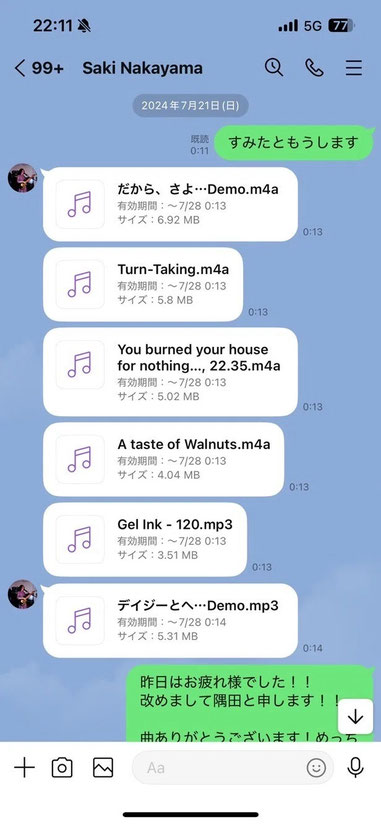
The LINE exchange that sparked starting the band.
Saki sent Sumita only the audio file without any explanation whatsoever
—Can you tell me why you guys decided to form a two-piece band? Did you have an idea of including a bassist?
Sumita: At first I was thinking of trying not to give her too much to do. It might be less work for her if we had have a bassist. But the thing is, you don’t find many people out
there who can share this kind of musical sense. As I was thinking that, Saki started to output her guitar tunes from the bass amp too, and then eventually started using two guitar amps. Then I
thought ‘What the hell is this, with the floral dress and such a vicious guitar tone?’ I ended up thinking that it would be fun to play like this as a duo.
—So eventually you ended up staying as a two-piece band?
Saki: I only started writing music after turning 30, and my first band was also a duo. So I think I might be more used to that. I used an octave pedal to get lower tones even
back then. So if we couldn’t find any other members, I could just come up with some kind of solution for it. Eventually, I came to really enjoy playing music in that setup.
—What kind of band were you in, that first time?
Saki: I went to New Zealand on a working holiday, but it was hard to come back to Japan because of the covid-19 lockdown and I ended up staying in New Zealand for 3 and a half
years. I had a friend from Auckland who asked me ‘Do you wanna jam sometime?’. We played cover songs like Joy Division or Pixies and such at first. One day he suggested something like ‘If we have
a few original songs, we could register at a band competition organised by a local bar. Then we took part in the competition and eventually we were in the semi-finals, where we needed to play a
30-min set with original songs. So we ended up writing a bunch of original songs in a couple of months. That band didn’t last long because I had got to go back to Japan.
—So that was your first band, meaning Grandma's Garden is your second band? Were you also writing songs by yourself in between?
Saki: I have been writing songs since I came back to Japan, so If I couldn’t find a drummer, I would think of putting out a solo release, which Ian also suggested to me actually.
I met Sumita-san at a moment when I was thinking about that, so it was a miracle.
Sumita: One thing I would complain to Ian is, ’Why didn't you give me a shout that there was someone looking for a drummer who loves QOTSA?’ (laughs). Well, I guess he
had no idea I like QOTSA…
— How did you decide on your band name ‘Grandma’s Garden’?
Saki: I had some ideas, but I asked around local friends at Uptown Records (record shop and bar in Koenji specialising in Chinese underground music and experimental rock from various
countries), ‘Which one would be the best?’ And they liked ‘Grandma’s Garden’.
──What's the origin of the band name itself?
Saki: (Points to the cover of the zine) This is my Grandma's Garden.
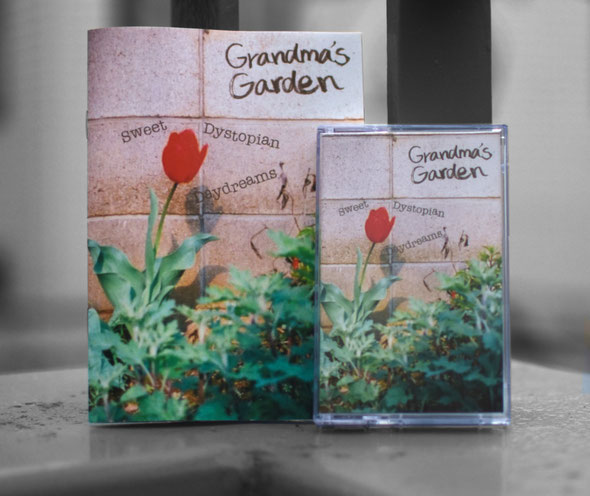
Artwork of ‘Sweet Dystopian Daydreams’
──What? So this photo came first?
Saki: Yes.
──I see. You usually decide on the band name first, then come up with song titles or album track names, and only then decide on the artwork, I suppose…
Sumita: (laughs)
Saki: At first, I had the idea of using this photo for the artwork of our EP. I've never been in a band before, so I don't really understand how that works
(laughs).
──So, you already had an idea for your EP as a conceptual piece from the very beginning, then.
Sumita: Usually, when naming a child, you don't think about choosing a name that will suit the clothes you want to dress them in (laughs). You usually think about things
like how you want them to grow up or what kind of person you want them to become and what kind of impact you want them to have on the world when naming them, right? That wasn't the case here
(laughs). It was more like, ‘I want to dress them in floral clothes, so I'll name them “Flower”’ — that sort of thing.
Saki: I’d hate having those kind of parents!
Sumita: I'd hate it if they were my kids, but for a band, I reckon it'd be fine (laughs).
──I often hear things like, ‘We got booked for a gig and had to slap a name on it in a panic,’ or ‘We wrote the songs first and then decided on the band name.’ Deciding the band name from the
artwork at the very last minute? That's one I haven't heard before.
Saki: Oh really? I've never been in an actual band before...
Sumita: That's not what he meant (laughs).
──You can't tell what kind of music you play from the band name, can you?
Saki: I wear a sort of floral dress and stuff, and then we have a band name like ‘Grandma's Garden’. Everyone thinks, ‘Oh, it might sound like dreampop or something,’ so
apparently they're surprised by what they hear.
Sumita: It's rare enough just to see women playing stoner rock.
Saki: I've been looking for others, but I really can't find any. The other day, Mori-san, the support bassist for P-iPLE (neccc, 満州候補者) told me, ‘Your playing style is so
bloke-like,’ and I was really happy to hear that (laughs). He went, ‘If I closed my eyes and listened to your tones, it'd sound like a dude with loads of tattoos playing’ (laughs). This might be
the best compliment I’ve ever had!
──You can't tell what kind of music QOTSA plays just from the name either, can you?
Saki: So maybe that's why Japanese people don't listen to them.
Sumita: Stoner rock bands often have pretty straightforward names, don't they? I recently discovered the band called Stoned Jesus. Isn't that brilliant? They're a Ukrainian band.
They were so cool.
About the EP 「Sweet Dystopian Daydreams」
— Your EP is being released from Call And Response. How did you meet Ian?
Saki: I met Ian at the Indie Camp (Indie Rock DJ party Produced by Pørtal at Koenji Substore).
It was just after I came back to Japan and I wanted to start my music. I also wanted to make some like-minded friends at some sort of parties. Ian and I got familiar because I speak fake British
English.
Sumita: I assume you can find Ian easily at any music events in Koenji. haha
Saki: I found Ian at The Cluracan (Irish pub that used to be in Koenji and moved to Nakano in April 2024) and we stayed there until the last order
(laughs). At that time, it was so embarrassing for me to show off my music and say ‘Hey, this is my music'. Then I needed to get drunk a bit to talk about it. It was about 3am when
I finally asked Ian to listen to my music and he went ‘This is really great! That led to the release of our EP.
Sumita: I think Ian tends to say ‘Let’s release your music, shall we?’ As soon as he finds new musicians.
#1 だから、さよなら
—Is it intentional that the first track literally reminds us of farewell?
Saki: I don’t know why it’s ‘Sayonara - means Goodbye’...This is the song I wrote after I just came back from New Zealand. I had a feeling of ‘this is the first track’ and Ian
also thought the same. This has the most weird and surprising vibes and so many breaks. I prefer songs that have many cool breaks. Sumita-san’s drumming is absolutely brilliant!
#2 Turn-Taking
Saki: I wrote this song when I was in my previous band. I was once told by my bandmate something like ‘This isn’t quite right’ when it comes to my guitar riffs. Sumita-san
doesn’t say anything much about the guitar riffs.
Sumita: What I think about a band is that each member has the right to decide their part by themselves. That’s because if another member says something like ‘This should be this
and that,’ it ends up being his solo work. I believe that the good thing about a band is that we get to play each part with our own creativity, and that each member has the right to decide what
to play for each part.
—What is the meaning of this title?
Saki: Something like, ‘It’s your turn next’. I wrote one of the lyrics ‘愛情見出す 友情言い出す’ to rhyme intentionally.
Sumita: That part’s not English, then.
—When you listen to this song without having a look at the lyrics, it might sound like English. ‘あい’ and ‘ゆう’ sounds something like ‘I’ and ‘You’.
Saki: I actually pay pretty close attention to that kind of thing! ’脳みそが狂う’ was also intentionaly written to sound like English!
Sumita: You seem in high spirits today (laughs)!
#3 A Tiny Wooden House
—Not only this song, but I noticed that your songwriting tends to use antonyms or have a structure of contrasting two things. Is that deliberate? Something like, you see yourself and others
in such a way.
Saki: It’s not a self-conscious thing, I suppose… but it might be influenced by some poetry and things like that. I don’t want to write a song that has lyrics which are too
direct or something like an encouraging song. Like, ‘The cloth you always wore is red~’...I think I like lyrics which are written in Japanese but do not exactly sound like Japanese.
—You don’t like direct phrases in English either?
Saki: I don’t think so…I would say the lyrics of Pulp songs are kind of direct, but they’re not like that, are they? Is that because their songs are pop, maybe?
—I suppose the lyrics of Pulp’s songs can only have been written from the cynical viewpoint of Jarvis Cocker?
Saki: True, so I would say like, ‘You can even bring your baby’ from Disco 2000 (laughs).
#4 ゲルインキ
—This song starts with a cowbell. Whose idea?
Saki: It was Sumita-san’s idea to start with a cowbell.
Sumita-san: I assumed QOTSA would play it like this.
—I think that's such a good intro as the first track of side-B on cassette tape, it’s catchy.
Saki: Ian told me exactly the same thing (laughs). Side-A finishes with the song ‘A Tiny Wooden House’ which ends like a song from Pixies, so that when listeners flip
over the tape, they feel like ‘Oh, that’s unexpected!’ One of my friends told me this song reminds him of Tool. I actually practiced playing my guitar by playing Tool. I think my guitar style is
influenced by Adam Jones.
—In your ZINE, only the lyrics of this song are displayed in your handwriting, aren’t they?
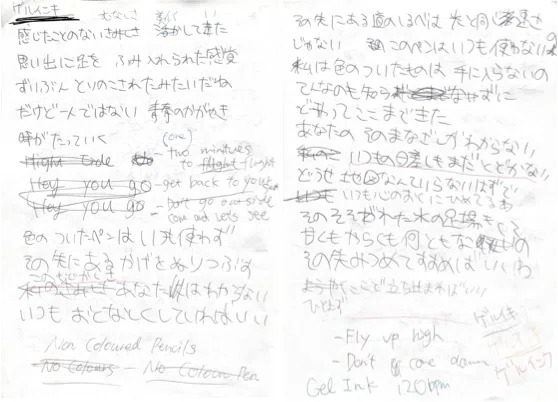
The lyrics of ‘ゲルインキ’ from the zine that comes with the cassette.
Saki: I thought it’s fun to have some parts written in Japanese when some listeners from overseas read them, so this part displays my handwriting. The reason why I created this
zine is that I just thought nobody would read any lyrics if they’re just printed in the sleeve. I'm the kind of person who enjoys reading lyrics while listening to music.
Sumita: I used to be rather taken with some liner notes that came with international CDs, you know the ones the lyrics were scribbled down in English.
Saki: Yes, that was super cool! This zine is all packed full of my aspirations.
—You mean your EP and zine have everything you wanted to do now, right?
Saki: That’s right. It’s like the bands described in the zine are all brilliant! You know, the bands we’re influenced by.
—How about your lyrics? It all ends up with some positive vibes, doesn't it? Do you think that reflects your character?
Saki: I’m not sure really, but I suppose it might be subconscious or something. I tend not to get too down. I always get depressed when I get a hangover, but I forget that if I’d
sleep enough.
#5 You Dyed Your Hair For Nothing
Sumita: This is my favourite, it’s stonerish.
Saki: I also like this song the most. Many friends filmed and posted this song on Instagram.
—Most of your songs are written both in Japanese and English, but this song is only in English.
Saki: Yeah, it’s only two phrases. I’ve once been told this song sounds kind of like Black Sabbath. This song was influenced by the song called ‘Why They Hide Their Bodies Under
My Garage’ covered by Gilla Band (the original is by Blawan). I just wanted to write this kind of song once.
Sumita: What do these lyrics mean?
Saki: It’s ‘You dyed your hair for nothing’ and ‘You burned your house for nothing’. I tend to write lyrics when I get a hangover (laughs). Actually, I might get some
ideas for my lyrics from books or films. I’ve enjoyed reading books since I was a kid. My favourite authors are Kazuo Ishiguro or the classic Jane Austen novels, Charles Dickens and such.
#6 デイジーとヘイター
Saki: Ian says ‘This song is pop and catchy’.
—What is suggested by ‘デイジー’ and ‘ヘイター’? Does ‘ヘイター’ literally mean ‘Hater’?
Saki: It might’ve had some sort of meaning, but I’ve completely forgotten it (laughs).
Sumita: What an answer for the interviewer! (Laughs)
—What is ‘quid’ in your lyrics?
Saki: ‘Quid’ means British Pound. I reckon it might be a casual way of saying pound in the UK. I just thought it would be fun when you listen to it and not sure if it’s either
Japanese or English. So I deliberately sing it in a Japanese way, like ‘Fa・i・ve・quiiiid’.
—What is ‘フォースター’?
Saki: It’s a beer called Foster’s. One of my favourite comedians is Ricky Gervais. I once saw him drink Foster’s during his stand-up comedy show, and I bought it at the bar and
enjoyed it when I went to see his show once. It was the time I was learning English, so I still remember I was able to have a laugh at the same time the locals did, you know, it’s such a happy
memory.
Grandma’s Garden in the future
—I noticed ‘We Keep Making New Music’ written on the back page of your ZINE. I assume this is your band’s announcement. As this EP is your first record, what are you guys aiming for from now
on?
Saki: I know this is completely my delusion, but something like this: one day QOTSA headlines the Fuji Rock Festival, and we get to perform at the Rookie A Go-Go state (a
stage for discovering new artists). And then I accidentally bump into them backstage or somewhere, and I’d be like ‘Oh my god! That’s Josh Homme!’, ‘You’re my guitar hero! I love your music!
Can I take a picture with you?’. And then I’d give him our records… say like, ’we’re huge fans of your music!’ (laughs). We’ve been asked to perform with some bands from overseas,
which I think is great. It would be cool to play more gigs alongside international bands. How about you, Sumita-san?
Sumita: What I’m going to do is just keep making sick-cool songs. I once had a chance to play along with Tatsuya Nakamura (drummer from Blankey Jet City) before. Then
sometime next, I’ll be playing along with MJQ which is a band of Kazuyuki Kuhara (drummer from Thee Michelle Gun Elephant). I’ve already had plenty of opportunities to perform with my
idols, so I feel that’s good enough for now. I wish I could have once had a chance to play with Kurt Cobain though. Other than that, I want to leave listeners feeling like ‘This drumming is
fuck’n cool!’, you know, this makes me motivated.
Saki: I have a lot of ideas for new songs in my head for now. I think our listeners will be surprised once they listened to our new songs! Some songs will have an intro with
Sumita-san’s drums.
—So, we can see Sumita-san’s characteristics in the future, can’t we?
Sumita: Yeah, I’ll go full speed ahead.
Saki: It’s like, ‘What are we going to play next?’ We’ve already had a few new songs, so I need to say ‘This is our new song’ every time at the gig (laughs).
Interview and Article: 武内庶民 (Shominn Takeuchi)
Translation: Saki Nakayama
WHERE TO FIND US: